
🛢️ Offshore and Oil & Gas Slip Rings: Key Requirements, Challenges, and Engineering Solutions
1. 🌊 Introduction
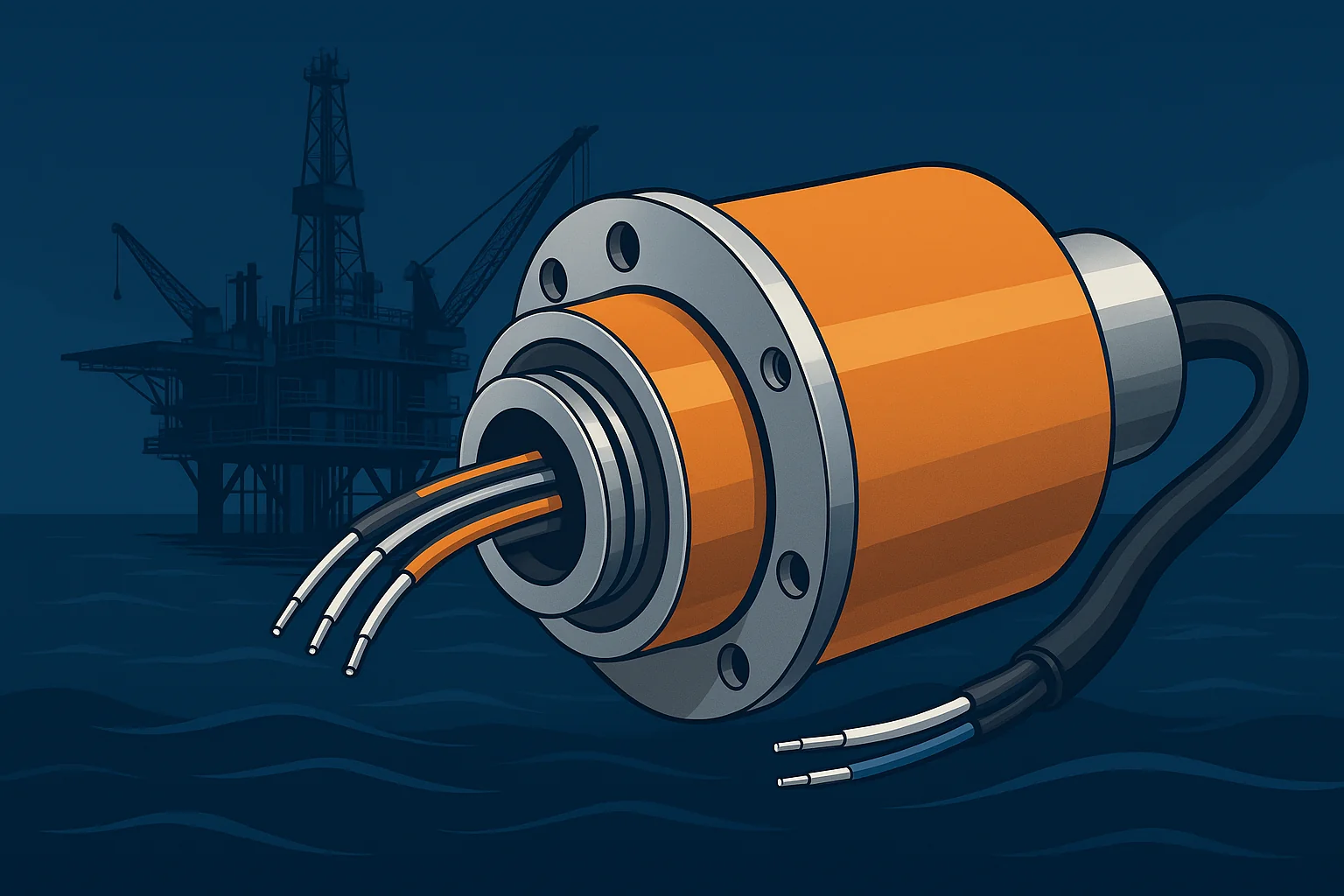
Offshore structures, drilling platforms, ROVs, and subsea systems require uninterrupted power and data transmission under some of the harshest conditions on Earth. Slip rings ensure 360° continuous rotation, electrical integrity, and long-term operational safety.
This article explains the essential engineering requirements, environmental challenges, and advanced slip ring solutions for Oil & Gas applications.
2. ⚙️ Why Slip Rings Are Critical in Offshore Operations
Slip rings enable:
- 🔄 Continuous rotation without cable twisting
- ⚡ High-current transfer for drilling machinery
- 📡 Stable signal and sensor communication
- 🔗 Hybrid power + data transmission
- 🤖 Real-time control for ROV and topside systems
- 🛑 Safe operation in ATEX / explosive zones
3. 🌧️ Environmental Challenges in Oil & Gas
3.1 🧂 Saltwater Corrosion
Seawater causes rapid corrosion. Material selection and protective coatings are critical.
3.2 💥 High Shock & Vibration
Drilling rigs, cranes, and winches expose slip rings to extreme mechanical stress.
3.3 🌊 Deep-Water Pressure
Subsea slip rings for ROVs must withstand high hydrostatic pressure.
3.4 🔥 Hazardous / Explosive Atmospheres
ATEX and IECEx-certified slip rings are required where flammable gases are present.
3.5 🥶 Temperature Extremes
From hot drilling zones to freezing offshore decks, temperature affects insulation and contact materials.
4. 🧰 Key Engineering Requirements
4.1 🛡️ EX-Proof / ATEX Designs
Explosion-proof housings with flame-path engineering ensure safe operation.
4.2 🧲 Corrosion-Resistant Materials
- 316L / Duplex marine-grade stainless steel
- Hard-anodized aluminum
- Nickel, silver, or gold-plated rings
4.3 💧 IP66–IP68 Protection
High-sealing housings, double O-rings, and anti-moisture barriers prevent water ingress.
4.4 🔌 Hybrid Power + Data Transmission
Supports:
- High-current circuits
- Low-noise analog signals
- High-speed Ethernet
- Fiber optic rotary joints (FORJ)
- RS485 / CANBus / video
4.5 🕒 Long Service Life
Minimal maintenance is crucial due to the extreme cost of offshore downtime.
5. 🛠️ Typical Offshore Applications
5.1 🤿 ROVs (Remotely Operated Vehicles)
Slip rings transmit power, video, sonar, and sensor data in TMS systems.
5.2 🏗️ Offshore Cranes & Winches
Enable 360° rotation during heavy-lift operations.
5.3 ⛽ Drilling Equipment
High-power slip rings deliver energy to top drives, rotary tables, and pipe-handling systems.
5.4 🚢 FPSO Turrets
Maintain continuous data and power transfer between rotating and fixed sections.
5.5 🔍 Subsea Inspection Tools
Pipeline inspection robots rely on rotating joints for stable, real-time signal transmission.
6. 🔬 Advanced Engineering Solutions
6.1 🌐 Fiber Optic Rotary Joints (FORJ)
For long-distance, high-bandwidth communication.
6.2 🌀 Contactless Slip Rings
Inductive or magnetic coupling eliminates brush wear, extending service life.
6.3 ⚖️ Pressure-Compensated Housings
Used in deep-sea applications for pressure balancing.
6.4 🧩 Custom Hybrid Assemblies
Combine power, signals, fluid rotary unions, and fiber optics into one compact module.
7. 🛠️ Maintenance Recommendations
- 🔧 Inspect seals and O-rings every 6–12 months
- 🛡️ Apply marine-grade anti-corrosion coatings
- 📏 Check contact resistance and brush wear
- 📉 Monitor vibration levels
- 🔌 Replace damaged connectors immediately
8. 🏁 Conclusion
Slip rings used in offshore and oil & gas environments must deliver exceptional reliability under extreme conditions. With proper engineering—ATEX safety, corrosion-resistant materials, advanced sealing, and hybrid data transmission—systems can operate safely and efficiently.
If you need EX-proof, subsea-rated, or custom-engineered slip rings, our team can support you with tailored solutions.